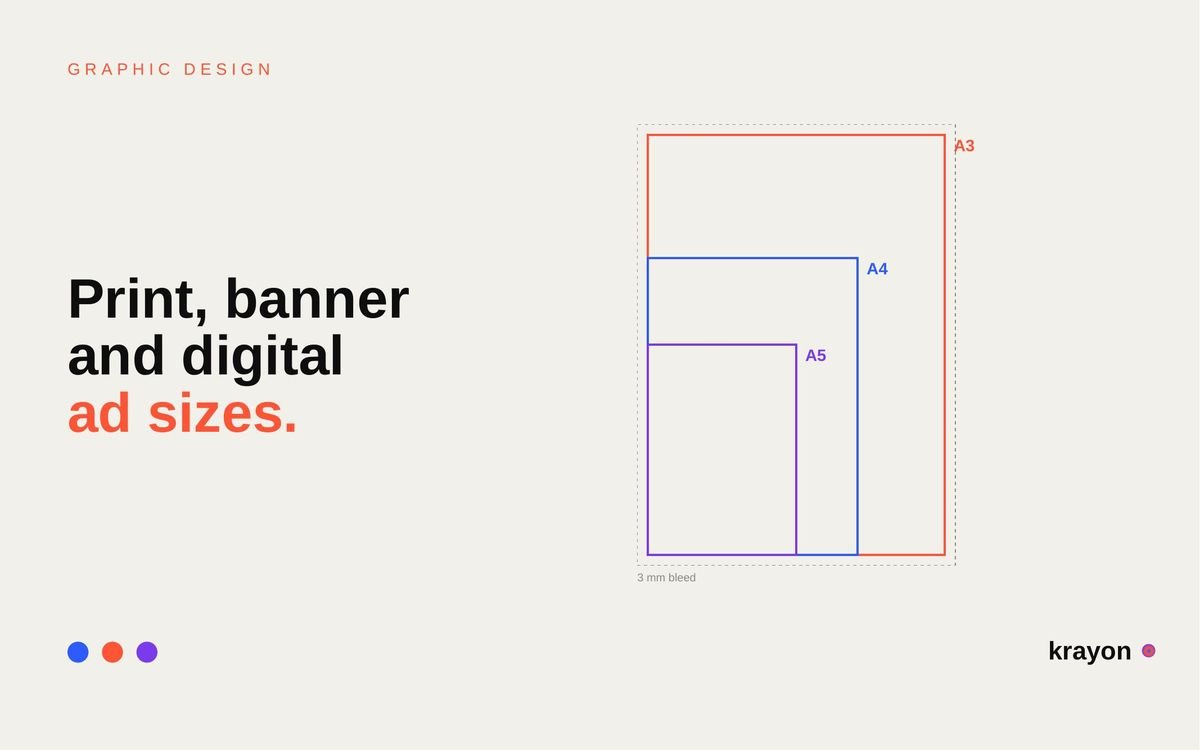
Print is unforgiving in a way screens are not. A post at the wrong size looks slightly off; a brochure at the wrong size is a reprint and an invoice. Here is every size worth knowing, and the three settings that cause most reprints.
Paper: the A series
The A series halves each time. A4 folded becomes A5, A5 folded becomes A6. That is the whole system, and it is why a design scales cleanly between them.
| A0 | 841 × 1189 mm | Hoarding artwork, exhibition |
| A1 | 594 × 841 mm | Posters, large signage |
| A2 | 420 × 594 mm | Posters, in-store |
| A3 | 297 × 420 mm | Menus, small posters |
| A4 | 210 × 297 mm | Letterhead, brochures, one-pagers |
| A5 | 148 × 210 mm | Flyers, invitations |
| A6 | 105 × 148 mm | Postcards, inserts |
Business and marketing collateral
| Business card (India) | 90 × 54 mm | Standard local size |
| Business card (US) | 88.9 × 50.8 mm | 3.5 × 2 inches |
| DL flyer | 99 × 210 mm | Fits a standard envelope |
| Bi-fold brochure | A4 folded to A5 | 297 × 210 open |
| Tri-fold brochure | A4 into three | 99 mm panels |
| Letterhead | A4 | Keep 20 mm clear at the top |
| Envelope DL | 220 × 110 mm | For a tri-folded A4 |
Large format
Large format is quoted in feet in India and designed in millimetres, which is where mistakes start. Agree the unit with the fabricator before anyone opens a file.
| Roll-up standee | 850 × 2000 mm | Keep the base 300 mm clear |
| Standee (3 × 6 ft) | 915 × 1830 mm | Common event size |
| Backdrop | 3 × 8 ft and up | Per fabricator template |
| Flex hoarding | Quoted in feet | Design at 1:10, export scaled |
| Canopy / table cover | Per fabricator | Always ask for the die |
| Danglers and standees | A3 or A4 | Cheap, and usually over-designed |
Digital display ads
Five sizes carry most of the inventory on the Google Display Network. Build fewer than these and your campaign quietly loses reach, because the ad server has nothing to fill the other slots with.
| Medium rectangle | 300 × 250 | The workhorse, desktop and mobile |
| Large rectangle | 336 × 280 | In-article placements |
| Leaderboard | 728 × 90 | Top of desktop pages |
| Half page | 300 × 600 | High attention, brand work |
| Wide skyscraper | 160 × 600 | Sidebars |
| Mobile leaderboard | 320 × 50 | Required for mobile |
| Large mobile banner | 320 × 100 | Better mobile performer |
| Billboard | 970 × 250 | Premium placements |
Uploaded static banners are capped at 150 KB regardless of dimensions. Responsive display assets allow far more, up to 5 MB per file.
Three settings that cause reprints
Bleed and safe area
Add 3 mm bleed on every edge, and keep anything important 5 mm inside the trim. Guillotines drift by a millimetre or two, and a logo sitting on the trim line will lose part of itself on some copies and not others.
Resolution is a function of distance
300 DPI at final size for anything held in the hand. A hoarding viewed from thirty metres needs nowhere near that — 20 to 50 DPI at full size is normal, and building a hoarding at 300 DPI produces a file nobody can open.
CMYK, not RGB
Convert before you send. A bright screen blue will come back duller in print because it sits outside CMYK gamut, and it is better to see that on your monitor than on the delivery. Ask for a physical proof on the actual stock for anything with a large flat colour or a gradient.
Ask the printer for their template before you design. Ten minutes at the start saves a reprint at the end.
Common questions
What size is a business card in India?
90 × 54 mm is the common local size. The US standard, 88.9 × 50.8 mm or 3.5 × 2 inches, is also widely printed. Either works — pick one and stay with it, because a mixed stack looks careless.
How much bleed does print need?
3 mm on every edge, with important content kept 5 mm inside the trim line. Cutting is never perfectly accurate, and bleed is what stops a white sliver appearing along an edge.
What resolution should a hoarding be?
Far lower than people expect. At normal viewing distance 20 to 50 DPI at full size is standard. Most large-format printers ask for artwork at 1:10 scale at 300 DPI, which gives the same result in a file that can actually be opened.
Which Google display ad sizes should I build first?
300 × 250, 728 × 90, 300 × 600, 160 × 600 and 320 × 50. Those five cover most available inventory. Uploaded static files must stay under 150 KB.
Why does my print look different from my screen?
Screens emit light and mix in RGB; print reflects it and mixes in CMYK. Saturated blues, bright greens and neons sit outside what CMYK can reproduce, so they come back duller. Convert to CMYK while designing so you see the real colour early.
Or hand the whole thing over.
We design print, packaging and campaigns, and deal with the printer so you do not have to. Production is billed at actuals with the vendor invoice shared.
graphic design →